Docomo · KDDI · SoftBank · and the one nobody can sell you
Which Japanese network does your eSIM use?
In Japan the brand on the eSIM matters far less than the carrier behind it. This page maps every provider onto a network, and every network onto real places.
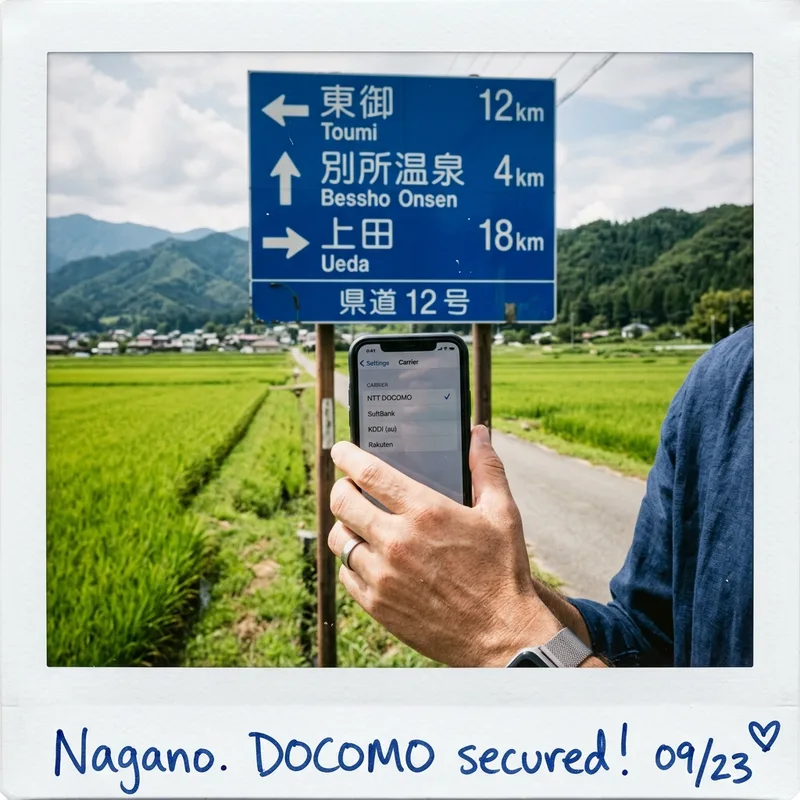
Why the carrier matters more in Japan than almost anywhere geography
Three quarters of Japan is mountain, and almost all of the population lives on the coastal plains. That shape decides everything about mobile coverage here.
On the plains, in the corridor from Tokyo through Nagoya and Kyoto to Osaka, all three sellable networks are excellent. Full 5G, complete subway coverage, service the whole length of the Shinkansen apart from the tunnels. If your trip stays there, the network question is genuinely irrelevant and you should buy the cheapest plan that fits your data.
Off the plains it stops being irrelevant fast. Building a tower in a valley that serves four hundred people is a decision each carrier made separately, and they made it differently. Docomo, as the former state monopoly with a universal-service history, built out the countryside first and kept building. The others did not, to varying degrees.
So the practical question is not "which eSIM brand is best for Japan". It is "does my route leave the plains, and if it does, which carrier does this eSIM ride".
The four Japanese networks and which of them you can buy
NTT Docomo <span class="jp">ドコモ</span>
The rural and mountain networkThe largest carrier and the one Japanese hikers, rural drivers and small-island residents carry, because it is the one with towers where nobody else built any. Kamikochi, the Nakasendo forest, Daisetsuzan, the Sanriku coast, the Shikoku mountain temples. If you can only have one Japanese network, this is the one to want. Sold by GigSky, Yesim and Ubigi.
KDDI <span class="jp">au / エーユー</span>
Excellent almost everywhereA close national second, and genuinely strong: the whole Tokyo to Osaka corridor, every Shinkansen line, the big cities on all four main islands. For a standard two-week first trip it is completely sufficient and the Docomo question never arises. Sold by Airalo, Yesim, Nomad and Ubigi.
SoftBank <span class="jp">ソフトバンク</span>
A city networkStrong in Tokyo, Kyoto and Osaka, and the first of the three to thin out on a mountain road. On most plans it is the second network rather than the one you are buying, which is a reasonable place for it. Sold as a secondary network by Airalo and GigSky, and at the airport tourist SIM counters.
Rakuten Mobile <span class="jp">楽天モバイル</span>
Not available to you at allThe fourth national carrier, built from scratch in the last few years, and not resold to travel eSIMs. No plan on this site rides it and no plan on any comparable site does either. Worth knowing only so that you stop looking for it.
Which provider rides which network published records only
| Provider | Japanese networks it publishes | What that means for you |
|---|---|---|
| GigSky | NTT Docomo + SoftBank | The only brand we can link with Docomo at the cheapest 10GB price. The default pick for any route that leaves the cities. |
| Yesim | KDDI + NTT Docomo | On paper the best pairing among the four we link. Priced above GigSky at 10GB and 20GB, and carrying a review history. |
| Airalo | KDDI + SoftBank | Excellent along the corridor, thinner in the mountains. The cheapest 20GB anywhere on this site. |
| Saily | not published | Third-party listings say KDDI. Saily will not confirm it. Fine in the cities, an unknown outside them. |
| Ubigi (unlinked) | NTT Docomo + KDDI | The two strongest networks on one profile, from a company owned by Docomo's parent group. We earn nothing from it. |
| Nomad (unlinked) | not published | Cheap big buckets, 50GB for $35, and no published network. We earn nothing from it either. |
Taken from each brand's own published Japan coverage record on September 4, 2026. Where a brand publishes nothing, this table says so rather than repeating a blog's assertion. Having two networks listed does not mean you pick between them by hand, though on most phones you can force one.
The short version of this whole page: GigSky if you leave the cities, Airalo if you do not. The price difference between them is about a dollar and the coverage difference is not.
See GigSky plans See Airalo plans Back to the full comparisonWhere each network actually matters place by place
Nobody can promise you a bar of signal at a specific address. What this table does is name the carrier each place leans on, so you know when the choice is free and when it is not.
| Where you are going | Network to prefer | What to expect |
|---|---|---|
| Where any network works | ||
| Tokyo, Kyoto, Osaka | Any | Full 5G on all three, including every subway line. The eSIM choice here is a pricing decision and nothing else. |
| The Tokaido Shinkansen | Any | Continuous service at 285 km/h with predictable drops in the long tunnels near Atami and Shin-Fuji. No plan you buy changes the tunnels. |
| Nagoya, Fukuoka, Sapporo, Hiroshima | Any | Major cities are well built out on all three carriers. This holds for the whole urban network across the four main islands. |
| Hakone, Nikko, Nara, Kanazawa | Any | The popular day trips are covered. The upper ropeway stations and forest switchbacks are where a SoftBank-first plan shows one bar for a few minutes. |
| Where Docomo pulls ahead | ||
| Kamikochi and the Japanese Alps | Docomo | The clearest case in the country. Docomo built the valley out for Japanese hikers; there is no wifi above the bus terminal to fall back on. |
| Nakasendo, Magome to Tsumago | Docomo | Both villages have service on everything. The forest walk between them is patchy on KDDI and thin on SoftBank, on a trail with one road and no shortcut. |
| Rural Hokkaido and Daisetsuzan | Docomo | Sapporo and Hakodate are fine on all three. Driving between them, or anywhere near the national parks, Docomo has towers and the others have gaps. |
| Sanriku coast and rural Tohoku | Docomo | Small towns, rebuilt infrastructure and long empty stretches of Route 45. Docomo is consistently the one still working. |
| Kumano Kodo and rural Wakayama | Docomo | Koya-san itself is fine. The pilgrimage routes below it are where travelers most often report an hour with no service. |
| Shikoku mountain temples | Docomo | The coastal cities are covered. The mountain stages of the 88-temple pilgrimage are the second-clearest Docomo case after the Alps. |
| Sado, Yakushima and the small islands | Docomo | One or two towers per island and the carrier they belong to decides your week. Docomo is the safe assumption. |
| Where nothing works | ||
| Long rail tunnels | None | The Seikan tunnel and the deep Shinkansen bores have no service on any carrier. This is expected behaviour, not a broken eSIM. |
| Inside caves, gorges and ferry crossings | None | Takachiho gorge, the Iya valley bottoms and mid-crossing on inter-island ferries drop everything. Download what you need first. |
Compiled from the three carriers' published coverage maps, Japanese mobile coverage reporting for 2026 and traveler reports through September 2026. We have not walked these routes with a signal meter and will not pretend otherwise. How we test.
How to force a specific network on your phone the switch nobody mentions
If your eSIM lists two networks, the phone chooses. Usually it chooses well. Occasionally it latches onto the weaker of the two, holds one bar, and refuses to let go while a stronger network sits unused. The fix takes fifteen seconds and almost nobody knows about it.
- iPhone: Settings, Cellular, tap the eSIM line, Network Selection, turn Automatic off. Wait for the list, then pick the carrier your plan rides: NTT DOCOMO or DOCOMO for GigSky, KDDI or au for Airalo.
- Android: Settings, Network and internet, SIMs, tap the eSIM, Automatically select network off, then choose from the list. Wording varies by manufacturer; on Samsung it is under Mobile networks.
- What you will see: networks your plan is not allowed to use appear in the list too, and selecting one gives you no service. If that happens, pick another or turn Automatic back on.
- Turn Automatic back on when you move. A forced network does not hand over gracefully when you travel out of its range, which is exactly the situation you were trying to fix.
The word to know: 圏外 (kengai) is what a Japanese phone says instead of "No Service", and it is written on train-line notices and posted at trailheads to mean "no coverage beyond this point". If you see it on a sign at the start of a mountain walk, that sign is talking about every carrier, not just yours. The carriers themselves appear in the network list as ドコモ or NTT DOCOMO, au or KDDI, and ソフトバンク or SoftBank, depending on the handset.
Japan network questions short answers
Which Japanese network is best for tourists?
NTT Docomo if your route leaves the cities, because it has the deepest rural and mountain coverage in the country. KDDI (au) if it does not, because it is excellent on the whole Tokyo to Osaka corridor and often available more cheaply. SoftBank is a city network and Rakuten is not sold to travel eSIMs at all.
Which eSIM uses NTT Docomo in Japan?
Among brands we can link, GigSky (Docomo and SoftBank) and Yesim (KDDI and Docomo). Among brands we cannot, Ubigi holds Docomo and KDDI and is owned by a company in Docomo's own parent group. Airalo does not have Docomo and Saily publishes nothing.
Can I choose which network my eSIM connects to?
Not at purchase, but usually at the handset. If your plan lists two networks you can turn off automatic network selection in the phone's cellular settings and pick one by hand. Selecting a network your plan is not permitted to use simply gives you no service, so switch back if that happens.
Does Rakuten Mobile work with travel eSIMs?
No. Rakuten is Japan's fourth national carrier and it does not appear in any travel eSIM's published coverage record. Every plan sold to visitors rides Docomo, KDDI, SoftBank or some combination of them.
Will my eSIM work on the subway and the Shinkansen?
Yes to both. Tokyo, Osaka and Kyoto subways have had continuous mobile coverage for years on all three carriers. The Shinkansen holds a connection along the Tokaido corridor with drops in the long tunnels, which affects every network equally.
Leaving the cities? Buy the Docomo one
GigSky publishes NTT Docomo and SoftBank, sells 10GB for $16.79 over thirty days, and gives away 100MB first so you can see which network your phone actually attaches to before you pay for anything.
See GigSky Japan plansSources & freshness: Network permissions from each provider's published Japan coverage record on September 4, 2026. Coverage characteristics from the three carriers' own published maps and Japanese mobile coverage reporting for 2026, plus traveler reports through September 2026. Rakuten Mobile's absence from travel eSIM agreements is visible on every provider's coverage list. We have not run our own signal tests in Japan and will say so until we have. How we test.