2026 · 6 providers · 56 plans · 3 networks that matter
Best eSIM for Japan
Picked by your route, not by hype. Starting with the question none of these companies puts on the buy button: which Japanese network are you actually buying?
Do you need an eSIM in Japan? six honest cases
AT&T and Verizon day passes run $10 to $12 a day and Japan is a two-week country. Ten days of roaming costs more than any plan on this page. GigSky 10GB at $16.79 ends that arithmetic before the Narita Express leaves the platform.
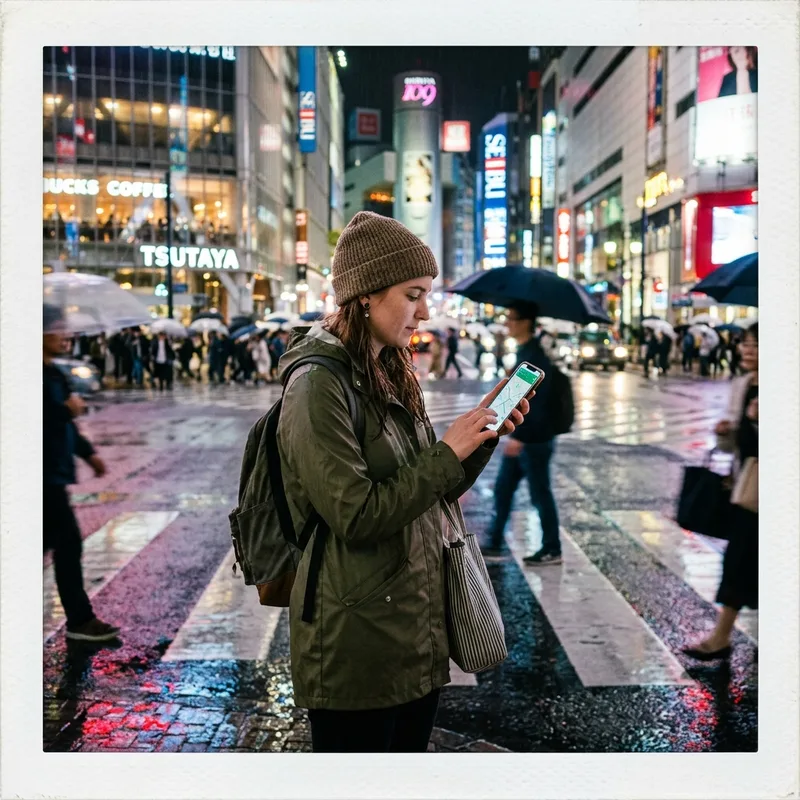
Japan Transit Planner, Google Maps and the Suica top-up screen are what actually run your trip, and all three want a live connection at the moment you are standing on the wrong platform. Offline maps do not know that the Yamanote line is suspended.
Some T-Mobile plans include Japan data at throttled speed. That is enough for LINE messages and not enough for a map redrawing while you cross Shinjuku station. Land, test it, and keep GigSky's free 100MB in the phone as the fallback.
Outside the cities the brand matters less than the carrier. SoftBank thins out first and Docomo does not. Only GigSky among the brands we can link publishes a Docomo agreement, and Ubigi, which we cannot link, has it too.
Japan is the one country where pocket wifi is still a serious answer. A group sharing one router at about ¥900 a day beats four eSIMs, and there is no daily cap. We priced it both ways, and we are an eSIM site saying it.
Every travel eSIM here is data-only. Japanese reservation systems, rental car desks and some hotel check-ins want a domestic number, and a foreign one is rejected outright. Three ways to get a real Japanese number, none of them a travel eSIM.
Your trip three taps, one answer
Answer three questions and we name the plan, with the reason written out. Already know what you want? Jump to the picks.
How long are you going for?
How will you use it? Pick everything that applies.
Where are you going?
The picks in short
GigSky
Best for most trips, and the only linkable eSIM on Docomo $16.79 10GB / 30 days- Publishes NTT Docomo and SoftBank as its Japanese networks. Docomo is the one that still holds a signal in the Alps and rural Hokkaido
- Cheapest 10GB and cheapest 1GB in this comparison, at $2.99 for a week
- Free 100MB for 7 days, no card, so you can prove the signal works at your hotel before spending anything
Watch out: It sells no true unlimited plan for Japan, and its 3.5GB-a-day packs get expensive fast: $44.99 for fifteen days.
Trustpilot 4.3/5 · 6,217 reviews
See GigSky's Japan plansAiralo
Best for the Tokyo to Osaka corridor $18.00 10GB / 30 days, Moshi Moshi- Rides KDDI (au) and SoftBank, both excellent along the whole Shinkansen corridor and in every big city
- Prints its unlimited cap in the plan details: 3GB a day, then 1 Mbps, which almost nobody else here does
- 20GB for $24.00 over 15 days is the lowest 20GB price on this page
Watch out: No Docomo. In the Japanese Alps, rural Tohoku and inland Hokkaido that is the difference between bars and no bars.
Trustpilot 4.1/5 · 41,885 reviews
See Airalo's Japan plansSaily
Best trust record, and the one to hotspot from $17.99 10GB / 30 days- Trustpilot 4.7 from 30,542 reviews, the best record of anyone here by a wide margin
- Unlimited with a published 5GB per day cap, the largest daily allowance sold for Japan
- 20GB for $24.99 over a full 30 days, the best big bundle if your trip runs longer than two weeks
Watch out: Saily publishes nothing about which Japanese network it uses, and reviewers on esimdb report its Japan traffic exiting through Hong Kong.
Trustpilot 4.7/5 · 30,542 reviews
See Saily's Japan plansYesim is the fourth brand we can link and it owns the top of the table at 30GB, which nobody else sells for Japan: $38.35 for 30 days. Trustpilot suspended its score during a fake-review cleanup and has since switched it back on, 4.3 across 2,942 reviews as of September 4, 2026. We say the history rather than pretending it did not happen. The full Yesim review explains when the saving is worth it.
Compare every Japan eSIM side by side
| Provider | Best for | Price anchor | Japanese network | Unlimited cap |
|---|---|---|---|---|
| GigSky | Most trips; the only linkable Docomo route | $16.79 / 10GB | NTT Docomo + SoftBank (published) | no unlimited; 3.5GB/day packs |
| Airalo | Cities and the Shinkansen corridor | $18.00 / 10GB | KDDI + SoftBank (published) | 3GB/day, then 1 Mbps |
| Saily | Best support record, hotspot, long stays | $17.99 / 10GB | not published | 5GB/day, then throttled |
| Yesim ¹ | The only 30GB plan sold for Japan | $18.59 / 10GB | KDDI + NTT Docomo (published) | no cap published |
| ubigi | The strongest network access in Japan | $16.50 / 10GB | NTT Docomo + KDDI (published) | unlimited 15 days $39, no cap published |
| nomad | Big buckets: 50GB for $35 | $16.00 / 10GB | not published | 2GB/day, then 1 Mbps |
Prices in USD, checked September 4, 2026, before any promo code. Ubigi and Nomad are listed unlinked because we earn nothing from either. Ubigi in particular is the brand ChatGPT and Perplexity both name first for Japan, it holds Docomo and KDDI, and leaving it out would make this table a lie. ¹ Hover the marker for the Yesim caveat.
The cheapest Japan eSIM at each size one row, one winner
| You need | Cheapest | Price | Runner-up |
|---|---|---|---|
| 1GB | GigSky | $2.99 / 7 days | Airalo $4.00 / 3 days |
| 3GB | GigSky | $7.49 / 15 days | Nomad $7.00 / 30 days, unlinked |
| 5GB | Airalo | $10.00 / 7 days | Yesim $10.23 / 30 days |
| 10GB | GigSky | $16.79 / 30 days | Airalo $17.00 / 7 days |
| 20GB | Airalo | $24.00 / 15 days | Saily $24.99 / 30 days |
| 30GB | Yesim | $38.35 / 30 days | nothing else sells 30GB for Japan |
Read the validity column, not just the price. Airalo's 5GB is 23 cents cheaper than Yesim's and expires twenty-three days sooner, which is the whole difference between a long weekend and a month. Airalo wins 20GB at 15 days; if your trip is longer, Saily's 20GB at $24.99 over 30 days is the one you want for 99 cents more. Nomad undercuts several of these rows and cannot be linked here. Checked September 4, 2026.
Two ways to act on that table. Take GigSky and get Docomo coverage at the lowest 10GB price on the page, or take Airalo for KDDI and the cheapest 20GB. If you are not leaving the corridor, that choice is worth about a dollar and no more.
See GigSky plans See Airalo plans Work out your size firstWho each provider is actually for plain answers
Your route leaves the big cities at any point, and you want the cheapest 10GB on the page while you are at it. The free 100MB trial means you can test it before paying.
Full review →Tokyo, Kyoto, Osaka and the Shinkansen between them, which is most first trips. Also the cheapest 20GB, and the only unlimited plan here with both numbers printed on the page.
Full review →You are hotspotting a laptop, staying three weeks or more, or the support record matters to you. The 4.7 from 30,542 reviews is earned, and the 5GB daily cap is the largest in Japan.
Full review →You want 30GB, which only Yesim sells for Japan, and you have read the Trustpilot history and decided it does not change your mind.
Full review →You want the best network access in the country and do not care that we earn nothing from it. Docomo and KDDI on one profile, and 10GB is $16.50.
Full review →Japan has four networks and your eSIM can only have three of them the Docomo problem
This is the part that decides whether your trip works, and almost nobody writes it down. In Japan the brand printed on the eSIM matters far less than the carrier behind it, because the carriers are not equivalent once you leave the cities.
NTT Docomo
The one that works outside the citiesThe deepest rural and mountain coverage in Japan, which is why Japanese hikers carry it. Kamikochi and the Japanese Alps, the Nakasendo trail, rural Hokkaido, the Tohoku coast, inland Shikoku. Of the four brands we can link, only GigSky and Yesim publish a Docomo agreement. Ubigi has it too, and we earn nothing from Ubigi.
KDDI (au)
Excellent almost everywhereA close second nationally and genuinely strong along the entire Tokyo to Osaka corridor, on every Shinkansen line and across the big islands. Airalo, Yesim and Nomad all ride it. For a first Japan trip that stays on the tourist spine, KDDI is more than enough and the Docomo question never comes up.
SoftBank
A city networkStrong in Tokyo, Kyoto and Osaka, first to fade in the countryside. It is usually the second network on a plan rather than the one you are buying, and it is what you fall back to when the primary drops. Airalo and GigSky both list it alongside their main carrier.
Rakuten Mobile, the fourth national network, is not resold to travel eSIMs at all, so no plan on this site rides it. The practical rule: a Tokyo, Kyoto and Osaka itinerary works on any of these, and the eSIM choice comes down to price. Add Kamikochi, Koya-san, the Tohoku coast or inland Hokkaido and Docomo stops being a detail. The full network page maps each carrier against real places.
If your route leaves the corridor, this is the whole decision. GigSky is the only eSIM we can link that publishes a Docomo agreement, and it is also the cheapest 10GB here at $16.79.
See GigSky Japan plans Read the network breakdownSources & freshness: Network permissions taken from each brand's own published Japan coverage record on September 4, 2026. GigSky lists NTT Docomo and SoftBank, Airalo lists KDDI and SoftBank, Yesim lists KDDI and NTT Docomo, Ubigi lists NTT Docomo and KDDI, and Saily and Nomad publish nothing at all for Japan. Where a brand publishes nothing we say so rather than repeating a blog's guess. Rakuten Mobile's absence from travel eSIM agreements is visible on every provider's coverage list.
What "unlimited" really means in Japan the caps in one table
| "Unlimited" plan | Real daily high-speed cap | After the cap |
|---|---|---|
| Saily Unlimited (30 days, $71.99) | 5GB/day | The largest published daily allowance sold for Japan, and about $2.40 a day. Saily does not print the throttled speed, only that it slows until midnight. If you actually use all five gigabytes daily this is the best value unlimited on the page. |
| Airalo Moshi Moshi Unlimited (30 days, $69.00) | 3GB/day | Drops to 1 Mbps for the rest of that day and resets at midnight. Both numbers are printed on the product page, which makes Airalo the only brand here you can plan around precisely. 1 Mbps still carries maps and messaging. |
| GigSky 3.5GB/day (15 days, $44.99) | 3.5GB/day | Not sold as unlimited at all, which is the honest version of the same product. The cap is in the plan name. It is also the only daily-cap plan in Japan that runs on Docomo. |
| Ubigi Unlimited (15 days, $39.00) · unlinked | none published | The cheapest fifteen days of unlimited in Japan by a distance, on the best network access in the country, and we earn nothing if you buy it. Ubigi does not publish a daily figure. |
| Nomad Unlimited (7 days, $25.00) · unlinked | 2GB/day | The smallest cap on this table. Two gigabytes is about an hour of high-definition video, so this is a maps-and-messaging plan wearing an unlimited label. |
| Yesim Unlimited (30 days, $63.91) | none published | Yesim mentions a fair usage policy and never gives the number. Cheapest of the linkable four for a month, and the only one where you cannot know what you bought. |
Every Japan "unlimited" plan is a daily allowance with a different name. Under about 1.5GB a day, a fixed 20GB pack at $24.99 is cheaper than any of them for a two-week trip. Figures from each brand's own published terms on September 4, 2026, not from a test. The full unlimited breakdown works out the price per real gigabyte.
If you want unlimited, buy the largest published cap rather than the cheapest sticker. Saily prints 5GB a day, Airalo prints 3GB and 1 Mbps, and two of the six brands here print nothing at all.
See Saily Unlimited Compare the capsHow much data a Japan trip actually uses real numbers
| Trip style | 5 days | 10 days | 14 days | 30 days |
|---|---|---|---|---|
| Maps, LINE, train apps, translation | 1GB | 2GB | 3GB | 6GB |
| Plus photos, stories, some video | 3.5GB | 7GB | 10GB | 20GB |
| Plus laptop hotspot and calls | 8GB | 16GB | 22GB | 48GB |
| Sizes that fit | Airalo 5GB | GigSky 10GB | Airalo 20GB | Yesim 30GB |
Assumes hotel wifi most nights, offline maps downloaded before you leave, and no video streaming over cellular. Japan pushes the top row up rather than down, because Google Translate's camera mode is genuinely how you read a menu here and it is not a light feature, and because the train apps re-query constantly when a line is disrupted. Convenience store and station wifi exists and is close to useless: it wants an email registration for every session. The full calculator breaks it down per app.
Where a travel eSIM works and where the network choice starts to matter place by place
Nobody can promise you a bar of signal at a specific ryokan. What we can do is name the carrier each place leans on, so you know when any eSIM on this page is enough and when the Docomo question becomes the only question.
| Where you are going | Network to prefer | What to expect |
|---|---|---|
| The corridor, where most trips happen | ||
| Tokyo and the 23 wards | Any | Full 5G on all three carriers, including the whole subway network, which has had continuous coverage for years. Every plan on this page is fine here and the choice comes down to price. |
| Kyoto and Osaka | Any | Dense on all three. The one soft spot is the bamboo grove and the Fushimi Inari upper trails, where everyone loses bars for a few minutes regardless of carrier. |
| The Tokaido Shinkansen | KDDI or Docomo | Holds a connection almost the whole way at 285 km/h, with predictable drops in the long tunnels around Atami and Shin-Fuji. Nothing you buy changes the tunnels. |
| Hakone and Nikko | Docomo or KDDI | Fine in both towns and on the main sightseeing loops. The Hakone ropeway and the upper Nikko switchbacks are where SoftBank-first plans start showing one bar. |
| Where Docomo stops being a detail | ||
| Kamikochi and the Japanese Alps | Docomo | The clearest case in the country. Docomo has built out the valley for Japanese hikers, the other two have not, and there is no wifi to fall back on above the bus terminal. |
| The Nakasendo trail, Magome to Tsumago | Docomo | The villages have service on everything. The forest sections between them are patchy on KDDI and thin on SoftBank, which matters because this is a walk with one road and no shortcut. |
| Rural Hokkaido and Daisetsuzan | Docomo | Sapporo and Hakodate are covered on everything. Once you are driving between them, or anywhere near the national parks, Docomo is the network with towers and the others are the ones with gaps. |
| The Tohoku coast and Sanriku | Docomo | Rebuilt infrastructure, small towns, long empty stretches of Route 45. Docomo is consistently the one still working, and this is not a route where you want to be guessing. |
| Koya-san and rural Wakayama | Docomo or KDDI | The temple town itself is fine. The Kumano Kodo pilgrimage routes below it are where travelers most often report an eSIM going dark for an hour at a time. |
| Islands and the far ends | ||
| Okinawa and Naha | Any | Naha and the resort strip are well covered on all three. The northern Yanbaru forest and the outer islands are thinner, and the ferries lose everything mid-crossing. |
| Shikoku and the 88 temples | Docomo | Takamatsu, Matsuyama and Kochi are fine. The mountain temple sections of the pilgrimage are the second-clearest Docomo case in Japan after the Alps. |
| Sado, Yakushima and the small islands | Docomo | One or two towers per island, and which carrier they belong to decides your week. Travelers consistently report Docomo working where their travel eSIM did not. |
Compiled from the three carriers' published coverage maps, Japanese mobile coverage reporting for 2026, and traveler reports through September 2026. We have not walked every one of these routes with a signal meter and we are not going to pretend otherwise. How we test.
Since April 2026 a Japanese data SIM wants your passport and a travel eSIM does not
This is new, it is barely written about in English, and it quietly changes the old advice. For years the standard line was that Japan is the easy country: unlike Thailand or China, nobody wanted your passport for a data SIM, so buying at the airport was a five-minute job. That is no longer the whole story.
The counters are still there. SoftBank runs tourist SIM desks in the arrivals halls at Narita, Haneda and Kansai, and Mobal will post a SIM to your hotel before you arrive. They are just slower than they were, and they still cost roughly ¥3,000 to ¥5,000, about $20 to $34, for 8 to 30 days. That is more than GigSky's 10GB at $16.79, and it happens after a twelve-hour flight rather than at home in your kitchen.
Two cases still send you to the counter anyway: a phone with no eSIM slot, and needing a Japanese phone number. The local SIM guide covers the shop route in detail, and the phone number page compares the three ways to get a domestic line.
Setting it up takes about four minutes before you fly
- Check the phone. Dial *#06#. If an EID appears, the phone takes an eSIM. If it is carrier-locked, sort that out first, because no eSIM works on a locked handset.
- Buy and install on home wifi. Install the profile before you fly. Do not plan to scan a QR code at the gate: the plan does not start counting until it connects in Japan, so waiting saves you nothing and costs you a working phone at immigration.
- Land, then switch. Turn the eSIM line on for data, leave your home line on for calls with data roaming off. That one toggle is what stops the $12-a-day charge.
- If it will not connect, set network selection to manual and pick the carrier your plan actually rides: NTT Docomo for GigSky, KDDI for Airalo. In the mountains it may be Docomo or nothing, and that is the coverage gap rather than a broken eSIM. Full setup and fixes.
Japan eSIM questions answered straight
Which eSIM provider is best for Japan in 2026?
GigSky for most trips: $16.79 for 10GB over 30 days, the cheapest 10GB here, and the only brand we can link that publishes an NTT Docomo agreement. Airalo at $18.00 if you are staying on the Tokyo to Osaka corridor, where its KDDI access is excellent. Saily if you tether a laptop, for the 5GB per day published cap and a 4.7 Trustpilot score across 30,542 reviews. Checked September 4, 2026.
Is Airalo or Ubigi better for Japan?
Ubigi, on network access alone. It rides NTT Docomo and KDDI, the two strongest networks in the country, while Airalo rides KDDI and SoftBank. Outside the big cities that gap shows up as bars on the screen. Airalo wins on app polish, on small short-trip sizes and on the sheer volume of troubleshooting advice online. We earn a commission on Airalo and nothing at all on Ubigi, which is exactly why we are telling you this. The Ubigi page has the full comparison.
Is it worth getting an eSIM for Japan?
Yes, unless your home plan already includes Japan. US carrier day passes run $10 to $12 a day, so a ten-day trip costs more in roaming than any plan on this page. Japan is also badly served by usable public wifi: station and convenience store networks exist but want an email registration for every session, and the apps you will actually live in, the train planners and the translation camera, need a live connection at the moment you are standing still and confused.
Which Japanese network does my eSIM use?
If it is GigSky, NTT Docomo and SoftBank. If it is Airalo, KDDI and SoftBank. If it is Yesim, KDDI and NTT Docomo. If it is Saily, the company does not say and we are not going to guess for them. That matters because Docomo is the only one of the three with dependable coverage in the Alps, rural Hokkaido, Tohoku and inland Shikoku.
Is 20GB of data enough for 2 weeks in Japan?
Comfortably. Two weeks of maps, LINE, train apps, photo uploads and a couple of hours of video a day lands around 12 to 15GB. 20GB is $24.00 from Airalo over 15 days or $24.99 from Saily over 30, and either leaves room to hotspot a laptop a few evenings. If you plan to stream on the Shinkansen every day, read the unlimited caps table above first.
What is the cheapest eSIM for Japan?
It depends on the size. GigSky is cheapest at 1GB ($2.99), 3GB ($7.49) and 10GB ($16.79). Airalo is cheapest at 5GB ($10.00 for 7 days) and 20GB ($24.00 for 15 days). Yesim is the only brand selling 30GB, at $38.35. GigSky also gives away 100MB for seven days with no card, which covers the airport and the train into the city.
Do Japanese eSIMs come with a phone number?
Not the ones on this page. Every travel eSIM here is data-only, and in Japan that matters more than in most countries: restaurant reservation systems, rental car desks and some hotel check-ins want a domestic number and reject a foreign one. Calls go over LINE, which is what Japan actually uses. Three ways to get a real Japanese number, none of them a travel eSIM.
Do I need to register a Japan eSIM with my passport?
Not a travel eSIM. Japan's Mobile Phone Improper Use Prevention Act was amended on 1 April 2026 to extend identity checks to data-only SIMs and eSIMs, so a Japanese data SIM bought at an airport counter or from a Japanese seller now requires a passport or residence card. A travel eSIM roams onto a Japanese network under a foreign operator's contract, so there is nothing to register and nothing to scan.
The only linkable eSIM on NTT Docomo
GigSky publishes Docomo and SoftBank as its Japanese networks, sells 10GB for $16.79 over 30 days, which is the cheapest 10GB on this page, and gives away 100MB for a week so you can test the signal before you spend anything. It also pays us the highest rate of the four brands we can link. Both of those things are true, and the Docomo access is why it is first.
See GigSky Japan plansSources & freshness: Plan prices pulled from esimdb.com and each brand's Japan product page on September 4, 2026, in USD, before promo codes. Airalo's own page geo-serves Canadian dollars from this connection, so its USD figures come from the esimdb table and its 3GB-a-day cap is quoted from Airalo's own FAQ text. Network permissions from each brand's published Japan coverage record on the same date; where a brand publishes nothing we say so. Coverage notes from the carriers' published maps and traveler reports through September 2026. Trustpilot scores checked September 4, 2026. The 1 April 2026 identity-verification change is the amended Mobile Phone Improper Use Prevention Act (携帯電話不正利用防止法). Pocket wifi prices from Japan Wireless and Ninja WiFi published rate cards. Prices move; we re-check monthly and date-stamp every table.